Bob Lazar in 1989 made explosive claims that changed UFO lore forever. He said he worked on reverse-engineering alien spacecraft at S-4 near Area 51 and revealed a mysterious fuel—Element 115—capable of bending gravity and powering advanced propulsion systems.
Decades later, Element 115, now known as Moscovium, was officially discovered.
When I first heard Bob Lazar say this, I felt that he may have intentionally selected the element right below Bismuth in the Periodic Chart because of the article in Scientific American a few weeks before he made his claims: “Creating Superheavy Elements” by Gottfried Münzenberg and Peter Armbruster in Scientific American, May 1989, Vol. 260, No. 5, p. 66. Read the Scientific American article.
If Lazar's story is true and he wanted to avoid revealing the actual material while still leaving a breadcrumb for someone who understood chemistry, pointing to the element directly below bismuth would be a clever way to say, “you are in the right neighborhood — but the answer is one floor up.”
Why Was Bob Lazar Never Prosecuted?
If Lazar had truly been brought into a buried UFO recovery program at S-4, he would not have been there on an ordinary badge. He would have needed Top Secret clearance, compartmented access, and a strict need-to-know authorization tied to a special access program. That is why the absence of prosecution becomes its own clue in the story. If he had exposed real classified propulsion secrets, the government would have had every reason to silence him through charges.
But if Lazar had only worked near Area 51 in a lower-security technical, contractor, or support role — close enough to hear rumors, see fragments, or misread compartmented activity, but not cleared into the real program — then prosecuting him would have accomplished nothing except draw attention to the facility.
In that version, the government ignored him not because the story was true, but because his access was too low, his claims were too unverifiable, and a public trial would have done more damage than his words.
The Special Element Used in Making UFOs?
Bismuth and element 115 belong to the same chemical family. They sit in the same vertical column of the periodic table, meaning they share a similar outer-electron structure. Bismuth has five outer electrons, and Element 115 is predicted to have the same general five-valence-electron arrangement one shell higher. In chemistry, that matters. Elements in the same column often echo each other’s behavior, even when their mass, stability, and nuclear properties are dramatically different.
The 1974 Dutchess County Airport Story
Let me share a tale from an area around the Old Dutchess County Airport in 1974 that I have heard from many pilots and people who worked for companies in that area. The story goes like this... Local companies did a lot of advanced reseach in upstate New York, just North of what was the Dutchess County Airport in 1974. Some people say a lot of research was done in converted barns. And in 1974 there were a lot of reports of people seeing a UFOs around the airport.
Inside one barn was a disc-shaped craft that looked like a UFO with a tall antenna coming out of the top. Also in that barn was an anti-gravity engine on a test stand.
The actual testing program in that barn was about communication with the craft. They had perfected the anti-gravity engines prior to this, but controlling the craft remotely was the real testing done in this particular barn.
The BFO Engine
At the center of the anti-gravity engine sat a suspended bismuth ferrite crystal — BiFeO3. Bismuth ferrite, BiFeO3, was not a modern invention. It was first reported in 1957, decades before Lazar’s Element 115 story. But its deeper importance emerged later: by the 1960s and 1970s, scientists recognized that it combined magnetic and ferroelectric behavior, and there is published research in the 1960s speculating its possible use in building an anti-gravity device.
Around it was a circular array of ultrasonic transducers submerged in a brown coupling liquid. The liquid was not the power source. It was the transmission medium. Without it, the engine would require a lot more voltage and tinkering to achieve resonance. But through the brown liquid, their energy became organized pressure — coherent, focused, and powerful enough to reach into the crystal lattice itself.
Surrounding the acoustic chamber was a second system: a set of high-voltage electric plates and toroidal magnetic coils. The electric field polarized the BFO core, forcing its internal charge structure into alignment. The magnetic coils then biased the ferric domains, giving the crystal a preferred magnetic axis. Alone, neither field produced lift. The electric field only prepared the lattice. The magnetic field only oriented it. The ultrasonic field was the key that made the whole system come alive.
The Resonance Moment
When the transducers fired in phase, they drove a rotating standing wave through the coupling liquid and into the BFO crystal. At the same moment, the electric and magnetic fields pulsed in synchronization with the acoustic wave. The ferric structure responded magnetically. The bismuth-rich lattice responded diamagnetically. The electric domains strained and released with each pressure cycle. For a few seconds, the crystal was no longer behaving as separate electrical, magnetic, and mechanical systems. It became one coherent resonant body.
There was one more critical component: a Blumlein pulse-forming line feeding a high-frequency resonant exciter capable of collapsing the voltage rise time into an extremely narrow window. It timed the electric field precisely enough to lock with the ultrasonic standing wave inside the BFO core. I may publish on my website for interested readers the schematic for such a Blumlein device that I have built and tested myself.
The engine was not pushing air. It was not throwing mass downward. It was not burning fuel. It was tuning the relationship between matter, inertia, and field geometry.
The polished BFO core began to shimmer inside the liquid chamber, not visibly at first, but on the instruments. Weight sensors fell. Magnetic flux readings bent sideways. The acoustic envelope tightened around the core like an invisible shell.
Once the harmonic stabilized, the bismuth-ferrite core entered an exotic state where its electron lattice, magnetic susceptibility, crystalline strain, and diamagnetic response moved together.
A thin exclusion shell formed around the craft. The field did not push against air, fuel, or the ground. It altered the local inertial frame, reducing effective weight and allowing the craft to rise in silence. If you were to draw gravity as a field that moves upward, the math would show that this gravity field bent around the craft when it levitated.
The Graviflyer Connection
The story above is just an old tale people tell... but what is below is a very real anti-gravity device.
A recent Russian device called the Graviflyer, developed by Alexey Chekurkov, appears to have come dangerously close to exposing part of the hidden principle behind the 1974 BFO engine: ultrasonic excitation combined with electricity, magnetism, and resonance.
It did not reveal the full secret, but it came close enough to show that the ultrasonic transducer was never a side component — it is the key critical to achieving resonance.
Alexey Chekurkov would spend hours tuning his Graviflyer, but if he just adds some modification to his acoustic generator he will achieve resonance in seconds.
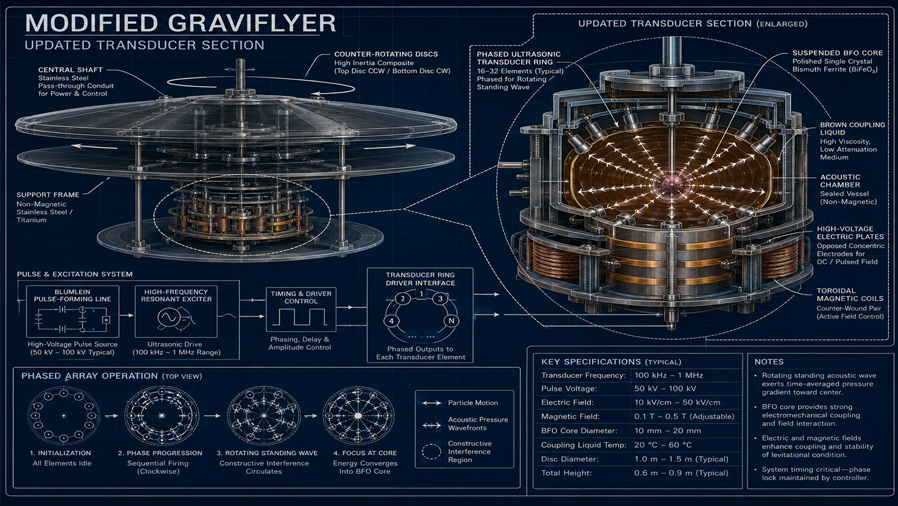
If Alexey Chekurkov modifies the design of his acoustic generator — making it phased, liquid-coupled, and tuned directly into the active core — the Graviflyer should achieve resonance in seconds be controllable in that you can move it around with a remote control.
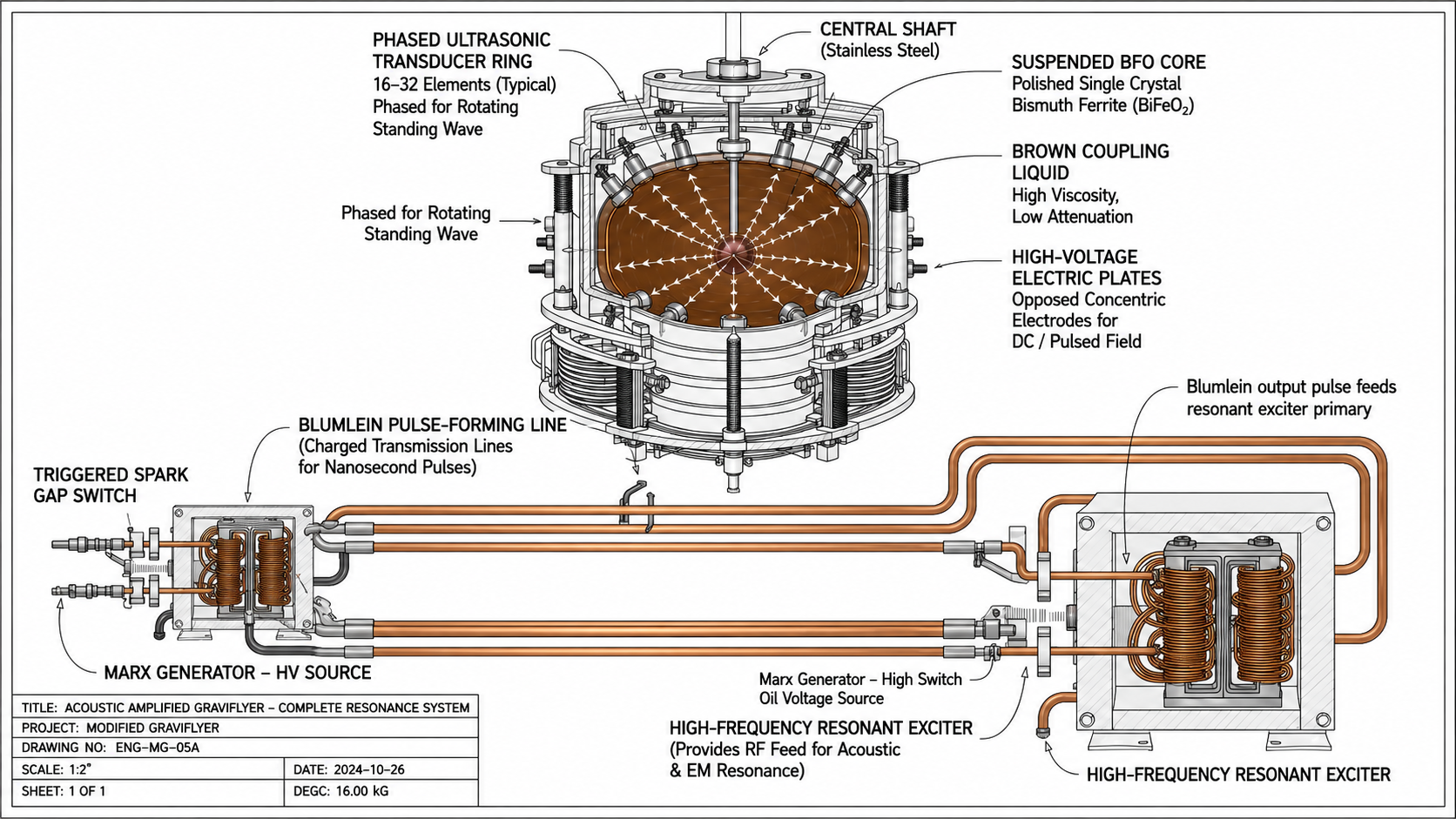
It opens the gate. The electric field polarizes the gate. The magnetic field aims it. The BFO crystal carries it. And the liquid makes the whole thing possible by transmitting the ultrasonic pressure pattern with enough precision to force the lattice into resonance.
Did I mention that the Graviflyer actually flies? YES... a guy in Russia tinkering around actually built an anti-gravity device similar to one tested in 1974 upstate New York.
See Alexey Chekurkov's Graviflyer flying: Watch the Graviflyer videos.
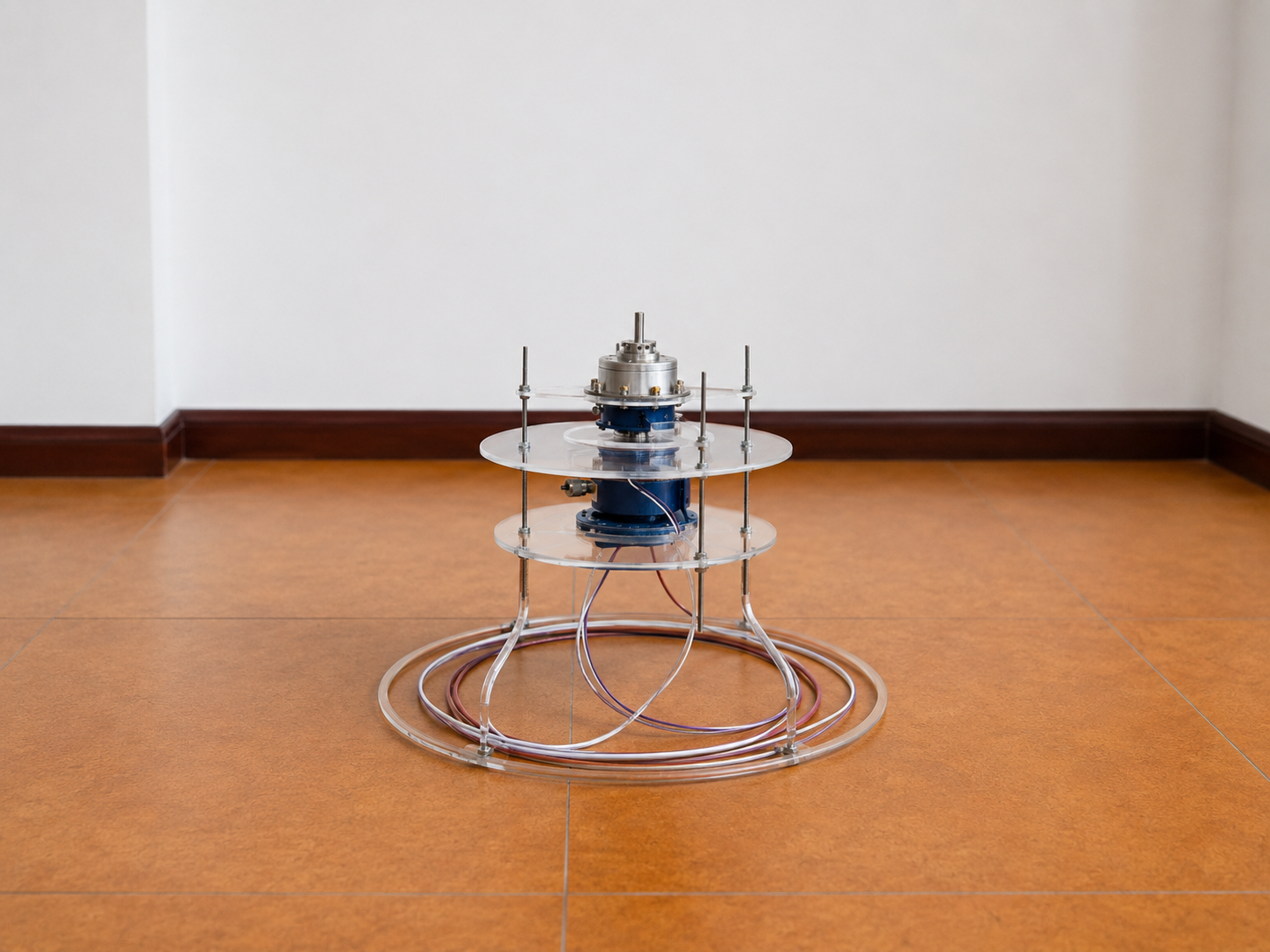 This is the Modified Version of the Graviflyer - A Real Aniti-Gravity Engine
Can YOU build a BFO engine in your garage for a few hundred dollars worth of parts?
I may publish the full schematic for a miniturized version of an anti-gravity BFO engine
for use in home drones. YES... they really work!
When I designed my own flight controller for drones using my Patent-Pending Zero-Training AI™, I also added controlling an array of ultrasonic transducers in a real anti-gravity BFO engine. If you are interested in testing my flight controller, let me know. GitHub Project: https://github.com/tvmogul/AiNoData
The Industrial Trail
When I heard this story from people about upstate New York in 1974, I began to do some research.
In 1974, while America obsessed over oil shortages and Watergate, two companies located in upstate New York quietly expanded their investments in technologies few investors understood.
Sprague Electric, already the nation’s undisputed leader in high-voltage capacitors, began filing patents for pulse-discharge systems capable of releasing enormous energy in fractions of a second.
At the same time, Corning Glass Works — best known publicly for cookware and television glass — was pouring millions into advanced ceramic dielectrics, materials engineered not for kitchens, but for containing electric fields so powerful they would tear ordinary matter apart.
Separately, these were explainable business decisions. Together, they formed a pattern. And patterns are where secrets live.
You can find many companies like Sprague Electric and Corning Glass Works who did important research for our country. I have no idea whether great companies like these may have contributed to anti-gravity research.
Alexey Chekurkov's Graviflyer did actually fly and you can watch his many videos of it flying.
Oh well... time for a cup of coffee. Oh crap! Coffee is a brown liquid...